Categories and filters
Logical categories, useful filters and sorting that help people narrow things down quickly.
Ecommerce web design
We design and build online shops that help customers find the right product, feel confident paying for it and get through checkout on a phone without any fuss. Then we make sure you can run the whole thing day to day without calling us.
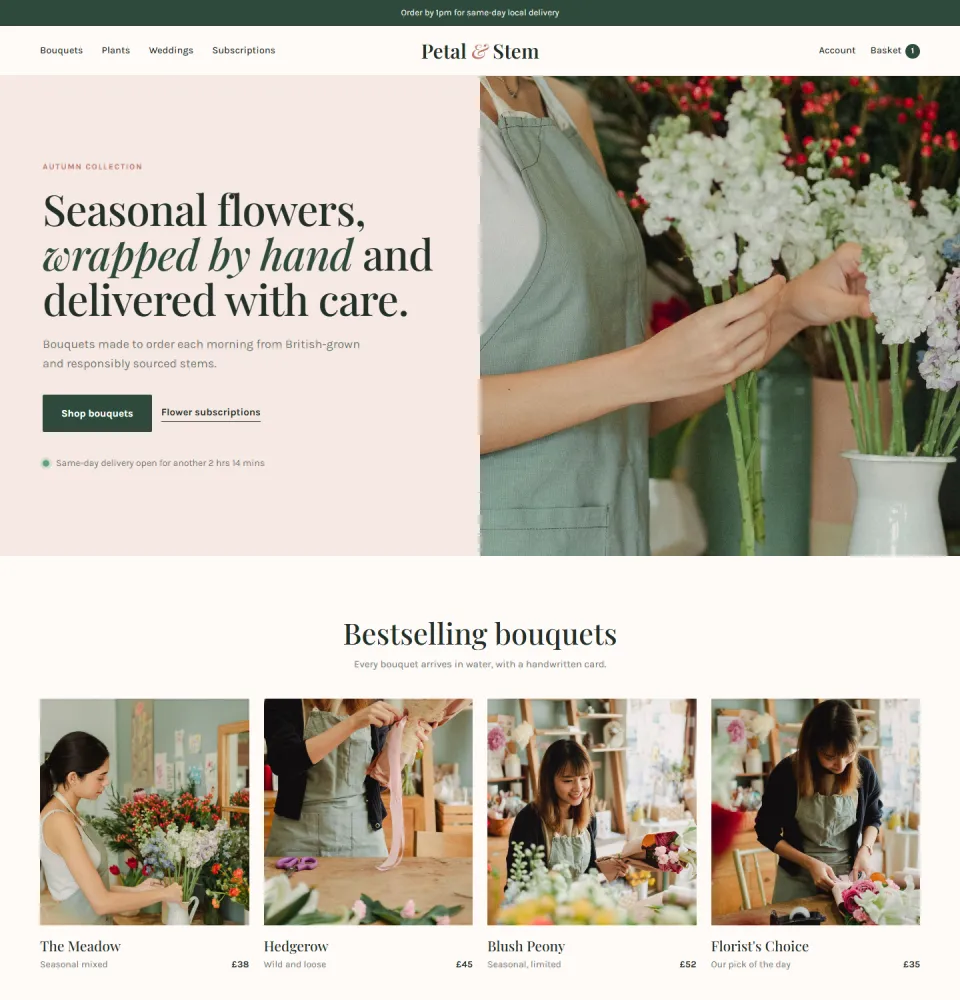

Studio concept for a fictional business

01Where shops go wrong
Nobody emails to say they gave up at your delivery page. They just close the tab. These are the sticking points we look for first, on new shops and existing ones alike.
Vague categories, no filters and a search box that returns nothing for a slight misspelling.
Delivery charges and dates that only appear at checkout are a classic reason for abandoned baskets.
Fiddly buttons, images that won't zoom and forms that fight with the phone keyboard.
Forced account sign-ups, repeated fields and surprise extra steps all give people time for second thoughts.
No clear returns policy, no real contact details and product photos that leave obvious questions unanswered.
02What we design and build
An online shop is a set of small journeys: browse, compare, decide, pay, come back. We design each one rather than leaving it to a theme's defaults.
Logical categories, useful filters and sorting that help people narrow things down quickly.
Clear photos, honest descriptions, delivery details and the buy button right where thumbs expect it.
As few steps as possible, guest checkout, and the payment options your customers actually use.
Shipping zones, costs and dates set up properly and explained long before anyone reaches checkout.
Order history, quick reorders and subscriptions for shops that rely on customers coming back.
Product, stock and order screens set up so day-to-day running is simple for you and your team.
03Choosing a platform
Both are solid platforms used by businesses of every size. The right one depends on how you sell, what the shop needs to do and how hands-on you want to be. Here's how they compare in broad terms.
| Compared | Shopify | WooCommerce |
|---|---|---|
| How it runs | A hosted platform. Shopify looks after the servers, security and software updates. | A free plugin for WordPress, running on hosting that you choose and control. |
| Running costs | A monthly subscription, plus payment fees and any paid apps. | Hosting, plus payment fees and any paid extensions. |
| Flexibility | Very capable, within the framework of Shopify's themes and app store. | Highly flexible, because you control the code, the data and the hosting. |
| Content and blogging | Built-in pages and blog, simpler than WordPress. | The full WordPress editor, ideal if guides and articles help you sell. |
| Upkeep | Very little technical maintenance on your side. | Regular updates and backups, which we can help with. |
| Often suits | Product-led shops that want to get selling and keep things simple. | Businesses mixing content with products, or needing custom features. |
Still not sure? That's what the first conversation is for. We'll recommend one and explain why, and if your shop is already on WordPress, our WordPress web design page covers how we build there.
04The practical details
Selling online in the UK comes with its own expectations. We make sure the practical details are set up properly, not left until launch week.
05Concept work
Holloway & Finch is a fictional coffee roaster we designed as a studio concept. The brief we set ourselves: make subscriptions as easy to find as single bags, show roast dates up front and keep everything feeling like a small, independent business rather than a supermarket shelf.
It's the same thinking we bring to real shops. Work out what makes customers hesitate, then design that hesitation away.
See real projects in our portfolio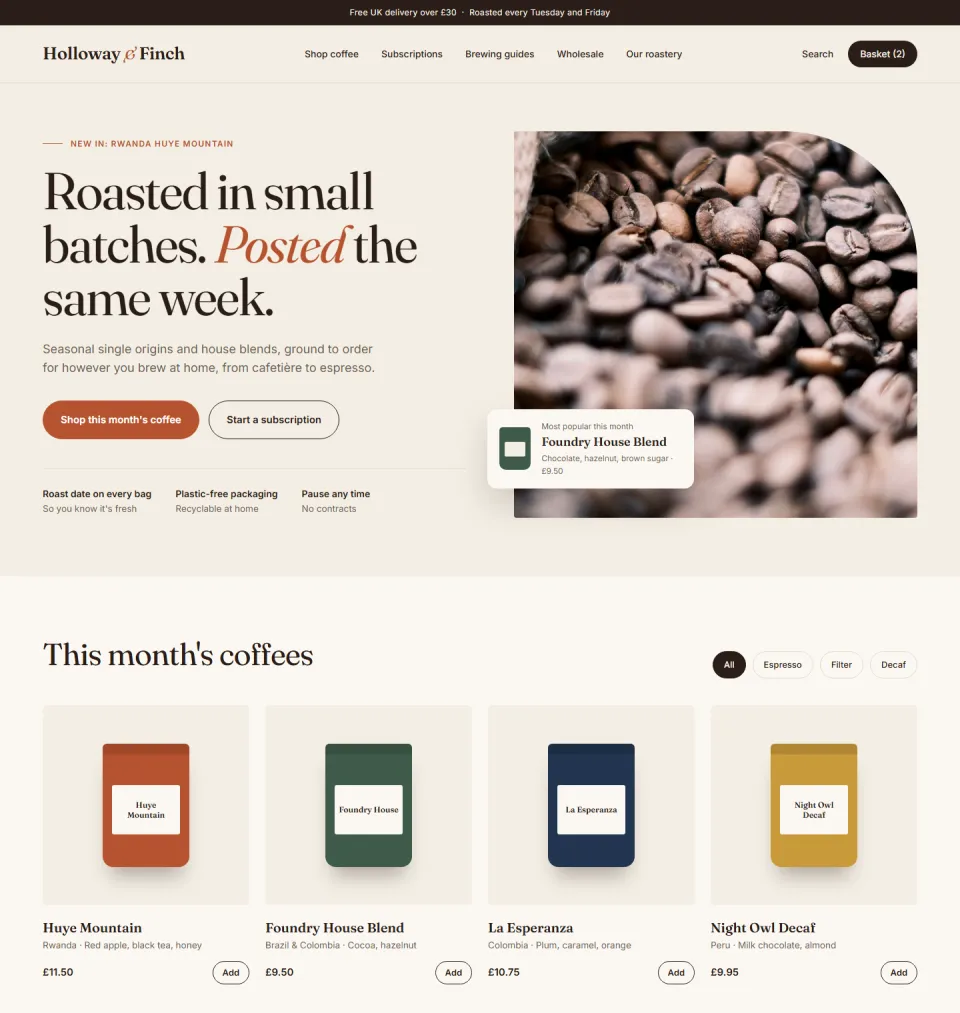

Studio concept for a fictional business
06Ecommerce FAQs
Send us a link to your shop and tell us what's frustrating you. We'll give you an honest view.
Get in touchIt depends on how you sell and how hands-on you want to be. Shopify is simpler to run because hosting, security and updates are handled for you, in return for a monthly subscription. WooCommerce gives you more freedom and keeps your shop and your content together in WordPress, but it needs decent hosting and regular updates. We'll talk through your products, budget and plans before recommending either.
Yes. Products, customers and order history can usually be migrated, although exactly what carries across depends on the platforms involved. We also redirect old product and category addresses to their new equivalents, so search rankings and old links keep working.
Most UK shops use a provider such as Stripe, PayPal or the platform's own payment service, and many add Apple Pay and Google Pay for a quicker mobile checkout. We'll set up the options that suit your customers and check that card authentication works smoothly on every device.
Yes. Both Shopify and WooCommerce have straightforward screens for adding products, changing prices, managing stock and processing orders. We'll walk you through it before launch and leave you with a short guide written for your shop.
We don't photograph products ourselves, but we'll advise on what to shoot, the sizes and angles you'll need and how to keep a consistent look across your range. We're happy to help write or tidy up product descriptions so they answer the questions customers actually ask.
Usually, yes. Subscriptions, pre-orders, gift cards and trade pricing are all possible on both main platforms, sometimes with an extra app or extension. We check your requirements early so the right tools are chosen from the start rather than bolted on later.
Related services
Start your online shop
Tell us what you sell, how you sell it now and where things get stuck. We'll come back with honest advice on platform, approach and next steps.
Tell us about your project
It takes about two minutes. Fields marked * are required.